Showing posts with label Indian. Show all posts

Anarkali Dress | Latest Designer Anarkali Dresses for any Occasion

| CLICK HERE TO VIEW REST OF THE ARTICLE »


Here are some beautiful various designed Indian Anarkali suits in defferent styles to match any occations.

Party Wear Indian Salwar Kameez Fashion Online

| CLICK HERE TO VIEW REST OF THE ARTICLE »

Rose and White Colors Long Sleeve Embroidery Salwar Kameez for Teenage Girls


Stylish Long Sleeve Chudidar Kameez Design Cream and Maroon Colors


Fantastic Cotton Salwar Kameez with Shawl Cream and Purple Colors


Black and Grey Cap Sleeve Salwar Kameez


Peacock Green Long Sleeve Salwar Kameez Designs


Purple and Blue Colors Sequins Sleeveless Salwar Kameez


Coffee Color Sort Sleeve Salwar Kameez with Duppatta


Orange Color Sleeveless Salwar Kameez

Jewelry for girls | Latest jewellery designs for women | Beautiful Necklace for women

| CLICK HERE TO VIEW REST OF THE ARTICLE »
Latest jewellery designs for women, most wishing by women in this stylish world..


beautiful Necklace for women, latest fashion, stone necklace,ear studs


beautiful Necklace for women, latest fashion, stone necklace,ear studs


beautiful Necklace for women, latest fashion, stone necklace,ear studs


beautiful Necklace for women, latest fashion, stone necklace,ear studs


beautiful Necklace for women, latest fashion, stone necklace,ear studs


beautiful Necklace for women, latest fashion, stone necklace,ear studs


beautiful Necklace for women, latest fashion, stone necklace,ear studs


beautiful Necklace for women, latest fashion, stone necklace,ear studs

Indian Sarees | About Saree | How to wear saree

| CLICK HERE TO VIEW REST OF THE ARTICLE »


About Saree
A sari or saree is a strip of unstitched cloth, worn by females, ranging from four to nine metres in length that is draped over the body in various styles. It is popular in India, Bangladesh, Nepal, Sri Lanka, Bhutan, Burma, and Malaysia. The most common style is for the sari to be wrapped around the waist, with one end then draped over the shoulder baring the midriff.

The sari is usually worn over a petticoat (लहंगा lahaṅgā or "lehenga" in the north, langa/pavada/pavadai in the south, chaniyo, parkar in the west, and shaya in eastern India), with a blouse known as a choli or ravika forming the upper garment. The choli has short sleeves and a low neck and is usually cropped, and as such is particularly well-suited for wear in the sultry South Asian summers. Cholis may be backless or of a halter neck style. These are usually more dressy with plenty of embellishments such as mirrors or embroidery, and may be worn on special occasions. Women in the armed forces, when wearing a sari uniform, don a short-sleeved shirt tucked in at the waist. The sari developed as a garment of its own in both South and North India at around the same time, and is in popular culture an epitome of Indian culture.


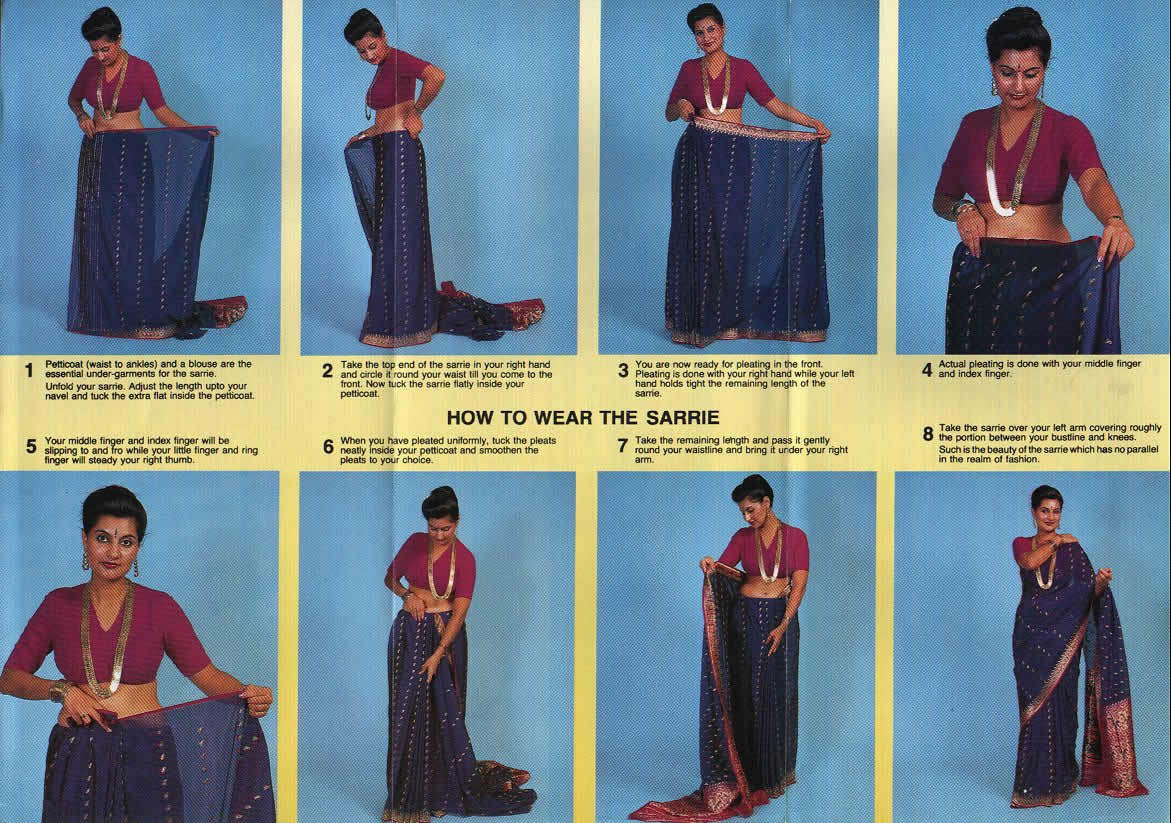
How to wear Saree


Instructions | Steps

Step 1: These are the "underneath" garments you need to wear before tying a Saree - a waist-to- floor length petticoat, tied tightly at the waist by a drawstring. You should not use elastic to hold the petticoat around the waist as the elastic might not bear the weight of the Saree. You have to wear an upper garment in the form of a tight fitting blouse that ends just below the bust. The blouse could be short sleeved or sleeveless. Its necklines can also be in different shapes and sizes.

Step 2: Now with your left hand hold the inside end of the Saree material .Tuck the top border of the inner end of the Saree into your petticoat starting at the navel, and complete one full turn from right to the left. Make sure that the lower end of the Saree touches the floor.

Step 3: Beginning from the tucked-in end start making pleats in the Saree, starting at the right, about 5 inches deep. Make about 7 to 10 pleats and hold them up together so that they fall straight and even. All the pleats should be at the same height off the floor.

Step 4: Tuck the pleats into the waist slightly to the left of the navel, and make sure that they are turned towards the left. Make sure the Saree is held there firmly. Tuck it in a little more if necessary and you can even use a safety pin to hold it in place.

Step 5: Drape the remaining fabric around yourself once more left to right, and bring it up under the right arm and over the left shoulder so that it falls to about the level of the knees.

Step 6: The end portion thus draped is the palled, and can be prevented from slipping off by fixing it at the shoulder to the blouse with a small safety pin.


For more details watch the following video


About Salwar Kameez | Indian Salwar Kameez | Pakistani Salwar Kameez | Bridal Salwar Kameez | Punjabi Salwar Kameez | Cotton Salwars

| CLICK HERE TO VIEW REST OF THE ARTICLE »


About Salwar Kameez | Indian Salwar Kameez | Pakistani Salwar Kameez | Bridal Salwar Kameez | Punjabi Salwar Kameez | Sotton Salwars


Shalwar kameez — or salwar kameez or shalwar qameez — is a traditional dress worn by both women and men in South Asia and Central Asia. Shalwar or salwar are loose pajama-like trousers. The legs are wide at the top, and narrow at the ankle. The kameez is a long shirt or tunic. The side seams (known as the chaak), left open below the waist-line, give the wearer greater freedom of movement.

Shalwar are gathered at the waist and held up by a drawstring or an elastic band. The pants can be wide and baggy or more narrow, and even made of fabric cut on the bias.

The kameez is usually cut straight and flat; older kameez use traditional cuts, as shown in the illustration above. Modern kameez are more likely to have European-inspired set-in sleeves. The tailor's taste and skill are usually displayed, not in the overall cut, but in the shape of the neckline and the decoration of the kameez. Modern versions of the feminine kameez can be much less modest than traditional versions. The kameez may be cut with a deep neckline, sewn in diaphanous fabrics, or styled in cap-sleeve or sleeveless designs. The kameez side seams may be split up to the thigh or even the waistline, and it may be worn with the salwar slung low on the hips. When a woman wears a semi-transparent kameez (mostly as a party dress), she wears a choli or a cropped camisole underneath it.

When women wear the salwar kameez, or sometimes known as the "Indian Suit" they usually wear a long scarf or shawl called a dupatta around the head or neck. For Muslim women, the dupatta is a less stringent alternative to the chador or burqa (see also hijab and purdah). For Sikh and Hindu women, the dupatta is useful when the head must be covered, as in a Sikh Gurdwara or a Hindu Temple, or the presence of elders. For other women, the dupatta is simply a stylish accessory that can be worn over one shoulder or draped around the chest and over both shoulders.

In Britain, Canada, and the U.S, especially during the last two decades, the garment has been transformed from an everyday garment worn by immigrant women from the region South Asia, mostly from Bangladesh, India, Nepal, Pakistan, and Sri Lanka to one with mainstream, and even high-fashion, appeal.

In India, the garment was a convenient and modest alternative to a sari - and also as one that flatters practically any body-type it is popular across the nation. By varying the fabric, color and the level of embroidery and decoration, the salwar-kameez can be formal, casual, dressy, or plain; and it can also be made to suit practically all climates.

Source: Wikipedia